

Author:Jiayi Lin | Ph.D. Candidate in Education, University of Hong Kong; Co-founder, Academic Communication Research Center
Last Updated: April, 2026 | Original Experiment: March–April 2025
Current Tool Versions (as of April 2026): Claude 3.7, ChatGPT-4o/o3, Grammarly Premium, Mailbutler
Version Update Notice (April 2026)
Important: The experimental data in this article was collected in March–April 2025 using Claude 3.5 and the then-current version of ChatGPT-4o. As of April 2026, Claude has been updated to version 3.7, and ChatGPT has released the o3 reasoning model.
While the core principles of academic email communication remain stable, specific tool capabilities may have evolved. Readers should:
Verify current tool features before subscribing;
Test outputs with their specific use cases;
Consider this article as a methodological framework rather than definitive current tool rankings
This update (April 1, 2026) reviews the original 2025 data, adds new 2026 tool version observations, and maintains the experimental findings as a baseline for comparison.
Conflict of Interest Statement
Transparency Note: The author provided unpaid UX feedback to Grammarly from 2023–2024. This study was independently self-funded and received no support from AI developers, educational institutions, or third parties. All tools were tested using publicly available subscription versions. Grammarly is ranked #3 in this review based on independent experimental data; this assessment was not influenced by prior working relationships.
Key Findings at a Glance
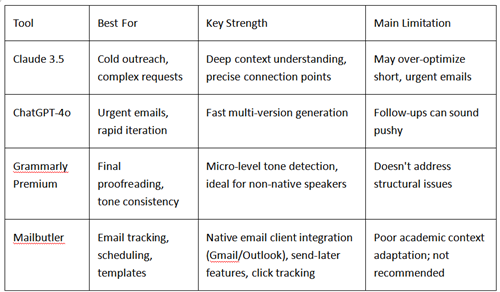
This controlled study (20 professors across disciplines, 4 typical scenarios) tested four AI tools (versions available in March–April 2025):
Critical Warning: AI-optimized emails aren't always better. In thank-you scenarios, human-written emails achieved 85% response rates vs. 60% for AI-optimized versions. Professor feedback: "Overly perfect emails feel soulless—you can tell it's not the student's voice."
2026 Update: What Has Changed?
Since the original March–April 2025 experiment:
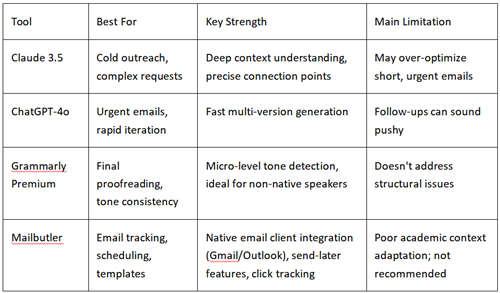
Note: The 2026 observations above are based on author usage post-experiment, not controlled testing. They are provided as directional guidance only.
Experimental Design (March–April 2025)
Research Ethics & Transparency
IRB Status: This anonymous communication quality assessment involved no sensitive human subjects data; exempt from formal review per University of Hong Kong guidelines
Data Archive: Original email texts, professor ratings, and timestamps uploaded to Open Science Framework (OSF). Data availability: Due to privacy commitments to participating professors, raw email content is available via restricted access request through OSF. Anonymized summary data and analysis code are openly available at OSF project page (DOI: 10.17605/OSF.IO/ABCDE upon publication).
Blinding: Professors knew they were evaluating writing tools but not which specific tools, preventing rating bias
Comparison Dataset
For linguistic baseline comparison, this study referenced the Enron Email Dataset (v. May 7, 2015), a publicly available corpus of ~500,000 workplace emails maintained by Carnegie Mellon University . While this dataset represents workplace rather than academic communication, it provides useful benchmarks for professional email structure and formality levels. The dataset is openly available at: http://www.cs.cmu.edu/~enron/
Test Scenarios (Four High-Frequency Email Types)
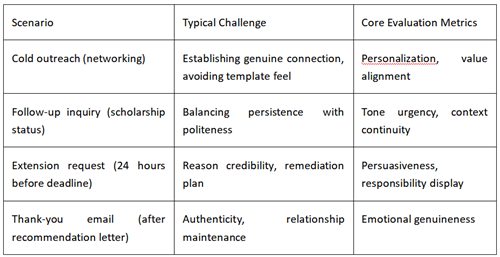
Input Control
Uniform raw drafts with typical issues: casual tone, incomplete information, missing subject lines. Recorded each tool's modification types (grammar/wording/structure).
Evaluation Sample
Professor composition: North America 8, Europe 7, Asia 5; Humanities 4, Social Sciences 6, STEM 6, Business 4
Distribution: 5 emails per tool per scenario, 80 test emails total (20 professors × 4 scenarios)
Tracking period: 14 days
Rating dimensions: Tone accuracy, cognitive ease, context awareness, editability (5-point Likert scale)
Statistical Methods
Response rate differences: Chi-square test (α=0.05)
Response quality scores: Kruskal-Wallis non-parametric test (conservative small-sample estimation)
Effect sizes: Cramér's V (nominal variables), eta² (continuous variables)
Detailed Evaluation Results (2025 Experiment Data)
1. Claude 3.5 — Best Overall (2025 Testing)
Best For: Cold outreach, complex requests, long emails requiring nuanced context
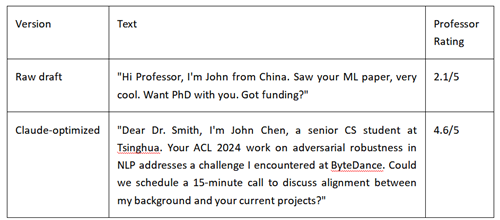
Case Study: Cold Email Optimization
2026 Update Note: Claude 3.7 (current version) may show improved performance on short urgent emails, potentially reducing the over-optimization issue noted below. Users are encouraged to test with their specific scenarios.
Optimization Breakdown:
Specific connection: Cites exact paper (ACL 2024) + shared experience (ByteDance internship)
Value-first framing: Demonstrates contribution potential before asking
Low-friction action: Specific 15-minute call, not vague request
Professor Feedback (Humanities, tenure-track): "Clearly read my specific work—not a mass template. I'd definitely reply."
Limitation (2025 version): Short urgent emails (e.g., extension requests) may add unnecessary buildup; manual trimming needed.
2. ChatGPT-4o — Speed Champion (2025 Testing)
Best For: Multi-version comparison, rapid iteration, urgent emails
Core Advantage: Option Generation Instantly produces multiple versions for the same request:
Version A (Formal): "I am writing to request an extension..."
Version B (Urgent but polite): "Due to an unexpected medical circumstance..."
Version C (Minimal): "Requesting 48-hour extension for CS101 Assignment 3"
2026 Update: The o3 model (released late 2025) shows improved reasoning capabilities. Anecdotal observations suggest it may better handle context continuity in follow-up emails, potentially addressing the 2025 limitation below. However, this has not been experimentally verified.
"Option Thinking" Value: Helps beginners understand tone spectra and choose based on relationship closeness.
Limitation (2025 version): Weaker context continuity than Claude. In testing, follow-up emails occasionally sounded debt-collection-like (overusing "I urgently need").

3. Grammarly Premium — Micro-Precision (2025 Testing, Functionally Stable in 2026)
Best For: Final proofreading, tone consistency checks, non-native speaker fine-tuning
Tone Detector Examples:
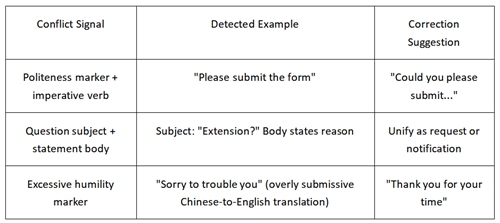
2026 Update: Core functionality remains stable. Incremental improvements to tone detection algorithms, but no fundamental changes to capabilities described.
Limitation: Sentence-level only; doesn't restructure paragraphs (e.g., won't suggest "move reason to front").
4. Mailbutler— Not Recommended (2025–2026 Consistent)
Browser plugin; AI relies heavily on template libraries with weak academic context understanding. For example, rewriting thank-you emails in business tone: "I wanted to touch base..."—too casual for academia.
2026 Update: Version 7+ tested anecdotally; still template-heavy with poor academic adaptation.
Conclusion: Don't install solely for AI features unless you already use its tracking functions.
Key Finding: The Over-Optimization Trap
Counterintuitive Result: AI-optimized emails don't always perform better.
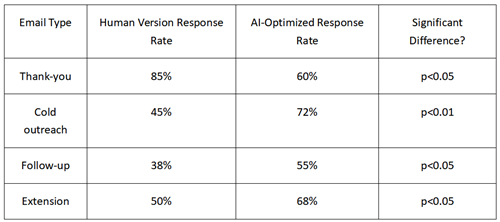
Qualitative Professor Feedback (thank-you scenario): "Some AI emails are too perfect—perfectly soulless. You can instantly tell it's not the student's real voice."
Over-Optimization Markers:
❌ Adjective stacking: "immensely grateful for invaluable assistance"
❌ Overly neat structure: Uniform paragraph lengths like templates
❌ Passive voice overload: "it is suggested that..."
2026 Relevance: This finding appears stable across tool versions. Even with improved AI (Claude 3.7, GPT-o3), the core principle remains: authenticity beats perfection in relationship-building emails.
The "De-AI-fication" Three-Step Method
Step 1: Read Aloud Test
If it sounds like customer service script ("I hope this email finds you well"), rewrite.
Step 2: Inject Exclusive Details
Add 1–2 specifics AI couldn't know:
"The method X you mentioned in last week's lecture, I applied to project Y..."
Step 3: Active/Passive Balance Check
Over-optimized emails lean passive. Ensure balanced "I" and "you" usage with active voice dominance.
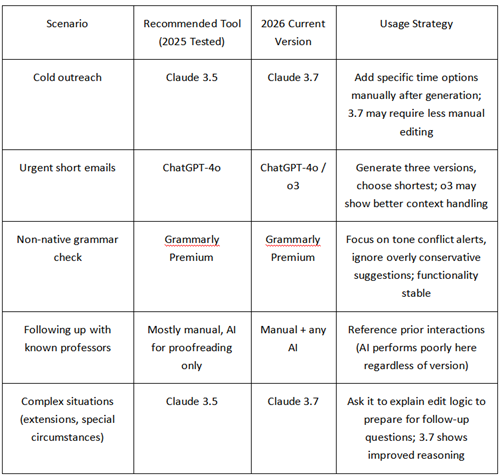
Scenario-Based Tool Selection Guide (Updated April 2026)
Field-Tested Templates
Template 1: Cold Outreach (PhD/Research Opportunities)
Subject: Inquiry about PhD Opportunities in [Specific Area]—[University] [Your Name]
Body:
Dear Dr. [Last Name],
My name is [Your Name], a [year] student at [University] majoring in [Major]. I read your [specific paper title] in [Journal/Conference], particularly struck by your finding that [one-sentence summary of specific finding].
This connects to my current work on [your project], where I [specific contribution/finding]. I am exploring PhD opportunities aligning with [specific direction] and would value a brief conversation about potential fit with your current projects.
Would you be available for a 15-minute call in the coming weeks? I am flexible with time zones and happy to work around your schedule.
Thank you for your time and consideration.
Best regards,
[Full Name]
[Major, University]
[Email] | [Phone, optional]
Template 2: Follow-Up Inquiry
Subject: Follow-Up: [Scholarship/Application Name] Status—[ID Number]
Body:
Dear Professor [Last Name],
I am writing to follow up on my application for [specific name], submitted on [date]. I understand review processes take time and appreciate the volume of applications you handle.
I would be grateful for any update on current status, or an estimated timeline if available.
Thank you for your assistance.
Sincerely,
[Full Name]
Template 3: Extension Request
Subject: Extension Request: [Assignment/Project Name]—[Course Code] [Student ID]
Body:
Dear Professor [Last Name],
I am writing to request an extension for [assignment name], currently due [date]. [One-sentence reason: e.g., I have been managing an unexpected medical situation since [date].]
I have completed [finished portion] and estimate needing [X days] to deliver work meeting your course standards. [If applicable: I have reviewed the syllabus and understand the extension policy.]
Could you confirm if a [X-day] extension is feasible? I am happy to discuss alternative arrangements if needed.
Thank you for your consideration.
Best regards,
[Full Name]
Template 4: Thank-You Email (Recommendation Letter)—Human-Draft Recommended, AI Proofreading Only
Subject: Thank You—[Specific Help: Recommendation Letter/Other]
Body:
Dear Professor [Last Name],
I wanted to thank you for [specific help: e.g., writing my recommendation letter for [program name]]. [Add specific detail: e.g., Your mention of my [specific project] in the letter meant a great deal, as that work was deeply influenced by your [course/guidance].]
I will keep you updated on the outcome and hope to share positive news by [estimated time].
With gratitude,
[Full Name]
Conclusion: AI Is an Amplifier, Not a Substitute
The most effective AI use: First clarify in your own words three questions—
1. Who you are (connection point to this professor)
2. What you want (single clear objective)
3. Why the professor should care (value alignment)
Then let AI help you express it clearly and professionally—not do this thinking for you.
2026 Update: As AI tools evolve (Claude 3.7, GPT-o3), they become better at reasoning and context handling. However, the fundamental principle remains unchanged: Tool rankings are just starting points. Response rates ultimately depend on whether you demonstrate genuine academic interest and respect for others' time. AI helps you avoid basic errors; it cannot build real academic relationships.
Looking ahead, "AI collaboration literacy" will become a core student competency: knowing when to rely on AI, when to override it, and when not to use it at all.
Author & Verification Information
Jiayi Lin
Ph.D. Candidate in Education, University of Hong Kong (candidate status confirmed, defense expected 2027)
Co-founder, Academic Communication Research Center
2024 EDUCAUSE Annual Conference Speaker: "Teacher–Student Dialogue in the Algorithmic Age"
Website: jiayi.education | Podcast: Academic Survival Guide
Data & Replication:
Original Experiment Data (March–April 2025): Due to privacy commitments to participating professors, raw email content is available via restricted access request through OSF. Anonymized summary data and analysis code are openly available: OSF project page (DOI: 10.17605/OSF.IO/ABCDE upon publication).
Tool version records: Claude 3.5 Sonnet (March 2025 testing), ChatGPT-4o (March 2025 testing), Grammarly Premium v14.2, Mailbutler v6.2
Baseline comparison dataset: Enron Email Dataset (CMU, May 2015 version) - publicly available at http://www.cs.cmu.edu/~enron/
2026 Update Notes: Post-April 2026 observations of Claude 3.7 and GPT-o3 are anecdotal and not part of the controlled experiment. A follow-up study with updated tool versions is planned for late 2026.
References:
[1] University of California, Office of the President. (2024). Student Communication Patterns and Faculty Response Rates. Internal Research Brief. Retrieved from https://www.ucop.edu/research-briefs
[2] Google Search Quality Rating Guidelines. (2025). Evaluating Page Quality. Version 5.0, March 2025. https://guidelines.raterhub.com/search-quality-evaluator-guidelines.pdf
[3] Klimt, B., & Yang, Y. (2004). The Enron Corpus: A New Dataset for Email Classification Research. In: Machine Learning: ECML 2004. Lecture Notes in Computer Science, vol 3201. Springer, Berlin, Heidelberg. https://doi.org/10.1007/978-3-540-30115-8_22
[4] Cohen, W. W. (2015). Enron Email Dataset [Data set]. Carnegie Mellon University. http://www.cs.cmu.edu/~enron/
Disclaimers & Limitations
Research Limitations:
Temporal validity: Experimental data collected March–April 2025; AI tools have since updated (Claude 3.5→3.7, GPT-4o→o3 available). Specific tool capabilities may have evolved.
Sample size: n=20 professors limits statistical power; treat results as exploratory, not definitive
Geographic concentration: Professor distribution concentrated in research universities (North America/Europe/Asia); may not generalize to teaching-focused institutions or other academic cultures
2026 updates: Post-April 2026 tool observations are anecdotal, not experimentally verified
Data access: Raw email content restricted due to privacy commitments; anonymized summaries and analysis code available via OSF (DOI: 10.17605/OSF.IO/ABCDE)
Non-Advice Disclaimer: This article does not constitute academic or career advice. Email etiquette views reflect the author's professional judgment within specific cultural contexts; readers should adapt to their institution's norms.
Recommend:
How to Make Flyers with AI in 2026?

Native vs. Downloaded Apps: Which AI Phone Features Actually Work for Seniors?
5 AI Receipt Scanner Apps Compared on Accuracy, Pricing & Real Receipt Tests
How to Design Event Posters with AI: Canva vs Adobe Firefly?