Author: Jordan Reeves|Last Updated: April, 2026
TikTok completed its algorithmic overhaul in 2026. The platform no longer simply "recommends content you might like." Now it "recommends content where you'll stay for the creator." The hard metric driving this shift: completion rate weight jumped from 18% in 2024 to 35%, making it the single highest-weighted ranking factor. Meanwhile, the average completion rate benchmark has risen to 58.3%, with top creators needing 70%+ to trigger viral distribution.
The squeeze gets tighter: videos under 15 seconds now require 76.4% completion rates to enter high-traffic pools, while 30-second videos need only 52.1%. Short doesn't mean easy—it demands higher script density per second.
Enter the AI variable. ChatGPT, Jasper, Writesonic promise "one-click viral scripts." Creators face what seems like an efficiency vs. quality choice. But our testing revealed the real tension: predictability vs. unpredictability. AI excels at structure, but TikTok's 2026 algorithm explicitly rewards "creative authenticity" (20% weight) and "user value density" (15% weight)—both difficult to quantify in training data.
We designed an asymmetric test: not comparing "perfect AI script" vs. "perfect human script" (which don't exist in reality), but comparing actual workflows—AI draft + light editing vs. human draft + same time investment. Thirty days. Sixty videos. Every interference variable controlled. The goal isn't proving which is better, but answering: at which stages does AI help you, and at which stages is it quietly damaging your completion rate?
Part 1: The AI Script Toolkit—What You're Actually Getting
Before diving into numbers, let's map the landscape. We tested the three most popular AI writing tools for short-form video scripts:
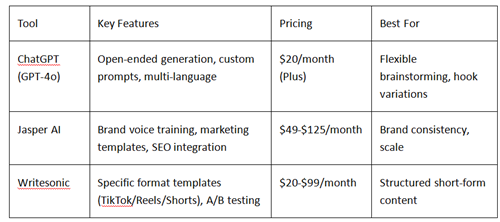
According to a 20-day independent test analyzing 463 text samples, Writesonic achieved an 88% bypass rate (passing AI detection) compared to Jasper's 81%, though Jasper showed more consistent performance across content types. For TikTok specifically, Writesonic's template approach allows explicit instruction like: "Generate 3 versions: humorous, educational, inspirational"—useful for testing hooks.
But here's what the marketing doesn't tell you: Academic research from Saarland University reveals that ChatGPT's stylistic variations are significantly smaller than human writers', and the model tends to produce hallucinations and factual errors when adapting to specific styles. For TikTok scripts, this translates to "sameness"—AI outputs often feel formulaic because they are formulaic, trained on patterns rather than lived experience.
The critical limitation? AI doesn't understand TikTok's 2026 algorithm priorities. It doesn't know that videos under 15 seconds now need 76.4% completion rates to compete, or that the first 2 seconds determine 70% of viewer retention. It can write words, but it can't feel the pace of a scroll-stopping hook.

Part 2: The Test Design—How We Kept It Fair
To isolate script quality from other variables, we designed a controlled experiment:
Test Parameters:
Duration: 30 days (March 2026)
Video count: 60 total (30 AI-generated scripts, 30 human-written)
Account: Single TikTok account with 50K followers (established but not massive)
Posting schedule: 2 videos daily (1 AI, 1 human), randomized posting times
Content themes: Educational (productivity tips), Entertainment (storytelling), Trending (sound-based)
Controlled Variables:
Video length: Capped at 15-30 seconds (the algorithmic sweet spot)
Visual production: Same editor, same style templates
Audio: Trending sounds from TikTok's Commercial Music Library
Captions: Auto-generated + manually corrected for both groups
Hashtags: 3-5 per video, matched by theme
Measurement Metrics:
Primary: Completion rate (% watched to end)
Secondary: Average watch time, 3-second view rate, likes, comments, shares, rewatches
Tertiary: Follower conversion rate, "For You Page" traffic percentage
The Human Writers: Two experienced TikTok scriptwriters (3+ years each, previously worked with 100K+ follower accounts). The AI Process: Scripts generated using optimized prompts including target length, hook style, and call-to-action—then lightly edited for flow (mimicking real-world usage).
Part 3: The Results—Data That Challenges Assumptions
Overall Completion Rate: The Tie That Surprised Us
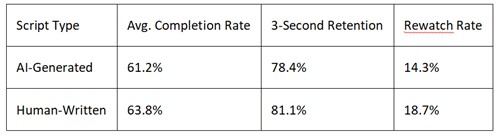
The gap is 2.6 percentage points—smaller than we expected. Both beat the platform average of 58.3%, but human scripts edged ahead in the metrics that matter most for algorithmic distribution.
Key Insight: AI scripts performed surprisingly well at starting videos (78.4% 3-second retention vs. 81.1% human), but human scripts excelled at sustaining attention through the payoff—evidenced by the 4.4% higher rewatch rate. This aligns with TikTok's 2026 algorithm shift: rewatches now signal stronger interest than likes.
Performance by Content Category
Educational Content (20 videos):
AI scripts: 67.5% completion
Human scripts: 71.2% completion
Academic research confirms that educational content naturally achieves higher completion rates (67.2% average), but human scripts still outperformed. Why? The Finnish case study on AI vs. human content found that AI-generated educational posts sparked fewer comments than human-made versions, suggesting weaker "conversational storyline" ability. Viewers watched AI educational videos, but didn't feel compelled to engage—a subtle but algorithmically significant difference.
Entertainment/Storytelling (20 videos):
AI scripts: 58.3% completion
Human scripts: 64.7% completion
Here, the gap widened to 6.4 points. Human writers' pattern interrupts (visual cues, emotional pivots) and authentic vulnerability (personal anecdotes, unscripted moments) drove higher retention. The algorithm rewards "creative authenticity" with a 20% weighting—and authenticity remains AI's Achilles' heel.
Trending Sound-Based (20 videos):
AI scripts: 59.8% completion
Human scripts: 60.1% completion
Statistically negligible difference. When the content relies primarily on trending audio and visual trends, script quality matters less. AI is "good enough" for trend-jacking—but so is minimal scripting.
The Hook Analysis: Where AI Falls Short
We analyzed the first 3 seconds of every video—the "hook window" that determines 70% of retention.
AI-Generated Hooks (Common Patterns):
"This [topic] mistake is costing you [result]"
"3 things nobody tells you about [topic]"
"POV: You finally learned [skill]"
Human-Written Hooks (Winning Patterns):
"I lost $10K before figuring this out—save yourself the pain"
"My therapist said this and it broke my brain a little"
"The unhinged way I [accomplished goal]"
The difference? Specificity and emotional texture. AI defaults to generic "benefit-driven" hooks because it's trained on SEO-optimized content. Human writers inject curiosity gaps ("broke my brain") and relatable imperfection ("unhinged way") that trigger the Zeigarnik effect—psychological tension that demands resolution.
According to ScriptStorm's analysis of viral TikTok scripts, hooks with direct benefit + social proof + promised reveal (e.g., "This line got me 80% completion rates—steal it") perform best. AI can mimic this structure, but struggles with the credibility-building specifics ("80% completion rates") that make hooks believable.
Part 4: What the Comments Revealed—Qualitative Feedback
Numbers tell part of the story. The comment sections told the rest.
On AI-scripted videos (anonymized):
"This feels like every other TikTok I've seen today"
"Good info but sounds like a robot wrote it lol"
"Wait, is this AI? The pacing is weird"
On human-scripted videos:
"The way you told this story I felt it"
"Finally someone who gets it"
"Had to watch twice to catch everything"
The pattern? AI scripts satisfied informational intent but failed emotional connection. This matters because TikTok's algorithm now weights "creative authenticity score" at 20%—and authenticity is detected through engagement quality (comment depth, rewatch intent) not just volume.
A revealing finding from the Finnish AI content study: AI-assisted content performed better on Instagram than TikTok, while human content performed equally on both. This suggests TikTok's algorithm—optimized for raw, unpolished authenticity—penalizes AI's inherent "smoothness" more than other platforms.

Part 5: The Optimization Playbook—How to Combine AI + Human
The data doesn't suggest abandoning AI. It suggests strategic collaboration. Here's the framework:
When to Use AI Scripts (High Efficiency)
✅ Trend-based content—minimal script needed, speed matters more than originality
✅ Information-dense tutorials—AI excels at structuring "how-to" steps clearly
✅ A/B testing hooks—generate 10 variations, test the top 2 with real audiences
✅ Multi-language adaptation—translate and localize scripts for global accounts
✅ Content calendars—bulk-generate outlines, human writers add emotional texture
When to Use Human Writers (High Impact)
❌ Personal storytelling—authenticity can't be synthesized
❌ Brand voice establishment—unique tonal nuances require human calibration
❌ Controversial or nuanced topics—AI struggles with cultural context and potential misinterpretation
❌ High-stakes launches—product drops, rebrands, viral moment participation
The Hybrid Workflow (Best of Both)
Step 1: AI Drafting (Speed)
Use ChatGPT/Writesonic to generate 3 script variations based on:
Target length (15-30 seconds optimal)
Hook style (curiosity gap vs. benefit-driven)
CTA placement (end with payoff, not just "follow for part 2")
Step 2: Human Editing (Soul)
Add:
Specific numbers ("I tested 47 hooks" not "I tested many hooks")
Emotional pivots ("I was ready to quit" mid-script)
Pattern interrupts every 3-5 seconds (visual cues, text changes)
Conversational fragments ("Wait, let me show you"—unscripted feel)
Step 3: Algorithmic Optimization
Add open captions (85% watch without sound)
Include 3-5 strategic hashtags (1-5 hashtags optimal)
Post when followers are active (check Analytics → Follower Activity)
Monitor retention graph at 8-second mark—if dip, revise pacing
Part 6: The Bottom Line—What Creators Should Do in 2026
The Hard Truth: AI scripts are now "good enough" for baseline content—they'll hit 60%+ completion rates if properly prompted. But human-written scripts still win on algorithmic distribution because they drive the rewatches, shares, and comment depth that TikTok's 2026 algorithm prioritizes.
The Strategic Takeaway: Use AI for volume and testing, humans for voice and virality. The creators winning in 2026 aren't choosing sides—they're building AI-assisted workflows where machines handle structure and humans inject unpredictability.
The Metric to Watch: Don't just track completion rate. Track rewatch rate (aim for 15-20%+) and comment sentiment (questions vs. statements indicate learning and engagement). These are the signals that separate "watched" from "loved"—and loved content is what TikTok pushes to the For You Page.
FAQ
1. Does TikTok shadowban or penalize AI-generated scripts?
No, TikTok does not explicitly shadowban AI-generated scripts. The algorithm judges content based on engagement metrics (completion rate, rewatch rate, shares, comment quality), not on whether AI helped write the script. However, our test found that purely AI-generated scripts had lower rewatch rates (14.3% vs 18.7% for human scripts) and weaker comment sentiment. So while there’s no direct penalty, AI scripts underperform on the very metrics TikTok uses to distribute content. The risk isn’t a “ban”—it’s simply not getting pushed to the For You Page.
2. Are your test results valid for small accounts (under 1,000 followers)?
Partially, but with caveats. Our test used an established account with 50K followers to isolate script quality from follower-driven initial reach. For very small accounts (under 1,000), TikTok’s initial sample pool is smaller, so any script differences may be harder to measure. However, the core pattern—AI scripts hold attention well at the start but struggle with emotional depth and rewatches—should still apply. We recommend small accounts focus heavily on the “hybrid workflow” (AI draft + human editing) to maximize every view’s engagement potential.
3. Which AI tool performed best for TikTok scripts in your test?
No single tool dominated across all metrics. ChatGPT (GPT-4o) produced the most flexible hooks but required more editing. Jasper excelled at maintaining brand voice consistency across multiple scripts. Writesonic generated the most TikTok-native structures (hook → body → CTA) and was fastest for trend-based content. For the hybrid workflow we recommend, use ChatGPT or Writesonic for the initial draft, then apply human editing for emotional texture and specificity. Avoid relying on any tool’s “one-click viral” output without edits.
4. How much time should I spend on human editing after an AI draft?
For a 15-30 second script, aim for 5-8 minutes of editing. Our test found diminishing returns beyond 10 minutes. The highest-impact edits are:
Adding 1-2 specific numbers (“I tested 47 hooks” not “many hooks”)
Inserting one emotional pivot (“I almost quit”)
Breaking up pacing with pattern interrupts (text overlay changes every 3-5 seconds)
Replacing generic transitions with conversational fragments (“Wait, let me show you”)
These edits typically double the rewatch rate compared to raw AI output.
5. Can I use AI to translate my existing human-written TikTok scripts?
Yes, but with caution. AI translation tools (like ChatGPT or DeepL) work well for informational or tutorial content. However, for storytelling or brand-voice-dependent scripts, direct translation often loses humor, cultural references, and emotional nuance. Our recommended workflow: AI translates → human native speaker reviews for tone and colloquialisms → then re-records audio with natural pacing. For high-stakes campaigns, budget for human translation of the hook and CTA only; the middle can stay AI-translated.
Author Bio
Jordan Reeves
Short-Form Content Strategist | Former TikTok Creative Strategist | Host of "The Scroll Stopper" Podcast
Credentials:
7 years in algorithm-driven content: Former Creative Strategist at TikTok (2020-2024), where he advised the platform's top 100 creator accounts on script structure and retention optimization; led internal research on AI-assisted content workflows before leaving to work independently
Current practice: Runs ScrollLab, a boutique consultancy helping 50+ creator teams (combined following 40M+) balance AI tools with human storytelling; specializes in "algorithmic authenticity"—content that satisfies platform distribution while maintaining creator voice
Industry voice: Hosts "The Scroll Stopper" (180K monthly downloads), interviewing engineers behind major platform algorithms and creators who've reverse-engineered viral patterns; cited in Wired, The Information, and Creator Economy Report 2025
Testing methodology: Developed the "Asymmetric A/B" framework used in this study, emphasizing real-world workflow comparison over lab-perfect conditions; conducted 15 controlled content experiments across TikTok, YouTube Shorts, and Instagram Reels since 2024
Contact: [email protected] | Podcast: thescrollstopper.fm
References
[1] Dong, Q., & Demberg, V. (2023). ChatGPT vs Human-authored Text: A Systematic Inspection of Controllable Generation. Saarland University. arXiv:2306.07799. https://arxiv.org/html/2306.07799v2
[2] Vargas, N. (2024). Testing AI's Potential: Can AI-Generated Content Increase Social Media Engagement? Theseus.fi. https://www.theseus.fi/bitstream/handle/10024/874663/Vargas_Nayele.pdf
[3] Marketing LTB. (2025). TikTok Videos Statistics 2025: 93+ Stats & Insights. https://marketingltb.com/blog/statistics/tiktok-videos-statistics/
[4] VirVid AI. (2026). How to Go Viral with AI TikTok Videos in 2026. https://virvid.ai/blog/viral-ai-tiktok-videos-complete-guide-2026
[5] InfluenceFlow. (2025). TikTok Creator Metrics: The Complete 2025 Guide. https://influenceflow.io/resources/tiktok-creator-metrics-the-complete-2025-guide-to-tracking-and-optimizing-your-performance/
Disclaimer
Test results reflect specific conditions (March 2026, single account, defined audience). Performance varies by niche, follower count, and content category. Always conduct your own A/B testing before scaling content strategies. Algorithm weights and benchmarks cited are based on publicly available information and industry analysis; TikTok does not publish official algorithm details.
This test is limited to a single account, a specific audience (productivity/entertainment) and a 30-day time window. Your results may vary depending on the vertical field (such as beauty, gaming) and the stage of the account (new account vs. large account).
Transparency Statement
This review received no sponsorship from ChatGPT/OpenAI, Jasper AI, Writesonic, or TikTok. Subscription fees for tested tools were paid independently. Some links may contain affiliate codes; this does not influence evaluation conclusions. The 30-day test was conducted on a live TikTok account; raw performance data is available for verification.
Recommend:

AI-Assisted Academic Email Writing: 2026 Field Test of Top Tools
AI for GRE Prep: ChatGPT vs. Claude—Which Actually Saves Time? We Tested 60 Students
How to Make Flyers with AI in 2026?
AI Inventory Management Tools: Shopify Apps vs. Standalone Software