
Author:Jake Morrison | Former GRE instructor (5 years, 300+ students), now freelance ed-tech writer|Last updated date: April, 2026
If you're prepping for the GRE, you've probably hit this brutal reality: doing practice problems only takes up a third of your study time. The rest? It's all spent figuring out what you got wrong.
You finish a practice set, check the answers, and see 15 mistakes. Then comes the hunt—flipping through books, scrolling forums, watching YouTube explanations. Three hours later, you're still stuck on three problems. Even worse, some explanations read like gibberish, and you're not sure you actually understand why you messed up.
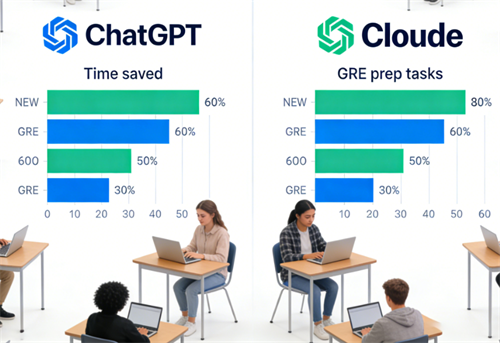
That's where AI tools look like a lifesaver. ChatGPT and Claude both spit out instant explanations—no book-flipping, no waiting for forum replies. But are they actually reliable? We rounded up 60 real test-takers, ran a 4-week comparison, and found something tricky: AI can save time, but use it wrong and you'll dig yourself deeper.
This article breaks down which tool works for what, and how to avoid the "fast but wrong" trap.
What We Actually Tested
We didn't just compare "problem-solving speed." We measured the full "mess up → understand → don't mess up again" cycle.
The problem with traditional prep isn't slow problem-solving—it's slow feedback. You miss a problem tonight, maybe fully get it tomorrow, and by day three you've forgotten your original thinking. AI promises to compress that multi-day delay into minutes.
We tracked four dimensions to see if AI actually delivers:
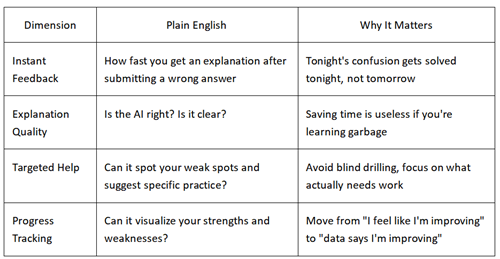
How We Ran the Test: Keeping It Fair
Participants: 60 real GRE preppers from mixed backgrounds (humanities/science, working/full-time students), randomly split into three groups:
Traditional Group: ETS official materials + Manhattan Prep forums + YouTube explanations
ChatGPT Group: GPT-4o for wrong-answer analysis, with specific prompt techniques we taught them
Claude Group: Claude 3.5 for analysis, leveraging its long-context strength
Controlled Variables:
Everyone took an official POWERPREP diagnostic first
Strict 10 hours/week for 4 weeks
Final POWERPREP test to measure improvement efficiency
Four GRE Question Types Tested:
Quant: Arithmetic, algebra, geometry, data analysis
Verbal Reading Comp: Long passages, logic, detail location
Verbal Text Completion/Sentence Equivalence: Vocabulary + sentence logic
Analytical Writing: Issue and Argument pool practice
We tracked problem-solving time and understanding time—the latter is where AI actually saves you hours.
The Results: AI Saves Time, But Has Boundaries
Quant (Math): ChatGPT Wins, But Watch for "Hallucinations"
Time Saved: ~70% on average
Real Scenario: Sarah, a test-taker, got stuck on a complex algebra problem—specifically, the final factoring step. She opened ChatGPT and typed: "I'm stuck on the last step. Solve this three ways and point out the most common mistake."
45 seconds later, she got:
Method 1: Standard factoring (what she tried, but missed a sign rule)
Method 2: Plug-in special values to verify (a quick GRE check technique)
Method 3: Graph estimation (GRE allows approximations)
Traditional Group Comparison: Book + forum search averaged 18 minutes, and they never found the "plug-in values" trick.
But Here's the Big Pitfall: ChatGPT occasionally "hallucinates" geometric properties. It might assume triangle ABC is right-angled when the problem never says so.
Bottom Line: Use ChatGPT freely for pure calculation problems. But for geometry, always cross-check with official explanations—don't trust it blindly.

Reading Comprehension (Verbal): Claude Wins, Excels at "Textual Evidence"
Time Saved: ~65% on average
Real Scenario: Mike kept over-inferring on long passages. He'd think the author "implied" something, but the answer said "not supported." He dumped the passage and question into Claude with a key prompt: "Analyze line by line using the text. Point out what I missed. Don't add anything not in the passage."
Claude marked up:
Paragraph 2, sentence 3 supports Answer A
Paragraph 4, sentence 1 directly contradicts Answer C
Your error: You read "would" as "will" (Paragraph 3, sentence 2)—possibility vs. certainty
ChatGPT Comparison: Tends toward "step-by-step short answers," often skipping text location and just saying "because the author believes..." without citing which sentence.
Bottom Line: Use Claude for reading logic. Force it to point to specific lines—prevents AI from making things up.
Text Completion/Vocabulary: AI Actually Slows You Down
Time Saved: -20% (slower, not faster)
Surprising Discovery: AI explains word meanings too broadly and misses GRE-specific "tested meanings."
Take sanction—GRE almost always tests "official approval," not "punishment." ChatGPT gave five definitions without flagging which one the GRE actually cares about. Test-takers wasted time memorizing irrelevant meanings.
Traditional Group Comparison: Official High-Frequency Words + real test context actually locked in the tested meaning faster.
Bottom Line: Don't use AI for vocabulary fill-ins—stick to official materials. AI can help with etymology for memory tricks, but word scope must come from real GRE questions.
Analytical Writing: Claude Builds Your Framework, But Examples Must Be Yours
Time Saved: ~50% for outlining, none for full writing (you must write yourself)
Real Scenario: Facing an Issue prompt—"Should education foster creativity or conformity?"—Claude gave Lisa:
Position A framework: Individual development angle, 3 sub-points
Position B framework: Social stability angle, 3 sub-points
Position C (balanced): The nuanced view high scorers often use
Each framework flagged what "ETS graders care about": Did you acknowledge the other side? Did you use specific examples?
Critical Limitation: Claude's examples are generic ("Steve Jobs dropped out and founded Apple")—overused to the point of hurting your score.
Bottom Line: Use Claude for argument frameworks, but find your own examples—personal experiences, professional knowledge, or obscure but specific cases.

3 AI Traps We Saw Firsthand
Trap 1: "Fast but Wrong" Is Worse Than "Slow but Right"
Week 2 testing: Three ChatGPT-group test-takers kept missing similar probability problems. Investigation showed they'd accepted a wrong AI explanation (on independent events) because "it looked convincing"—without verifying.
Fix: After any AI explanation, do one verification step—recalculate key numbers or cross-check official materials. Don't spend all saved time on more problems; reserve 15% for quality control.
Trap 2: "Prompt Fatigue" by Week 3
Test-takers started copy-pasting mechanically, no longer actively thinking "why did I miss this?" AI became a "fast answer machine," not a learning partner.
Fix: During weekly review, explain your mistakes out loud without looking at the AI explanation. Can't explain it = you don't really get it.
Trap 3: ETS May Detect AI-Generated Writing
AW scoring doesn't currently check for AI, but ETS has publicly stated they're researching detection tools. Submitting full AI-generated essays is risky.
Hard Rule: AI is for outlining and logic checking only—full essays must be written by you.
Your 4-Week AI Prep Plan:
Week 1: Build Your Workflow
Quant: ChatGPT for explanations, but flag geometry problems for "needs verification"
Reading: Claude for analysis, mandatory "cite the specific line" requirement
Vocab: No AI—use official materials
Writing: Claude for outlines, you fill in examples
Weeks 2-3: Targeted Improvement
Have AI analyze your "error patterns": "What type do I keep missing?"
ChatGPT Code Interpreter can analyze your wrong-answer Excel and generate weakness heatmaps
Week 4: Simulate Real Test Conditions
Turn off AI for full practice tests—mimic exam conditions
Use AI only for post-test review, comparing "with AI help" vs. "without"
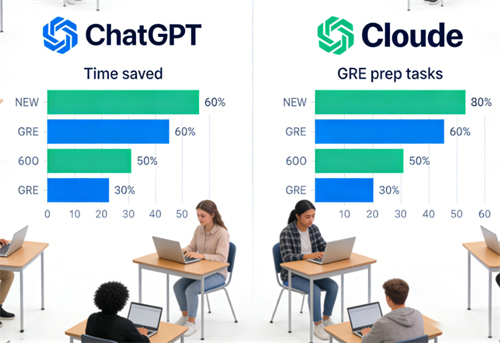
The Time Breakdown: How Much Do You Actually Save?
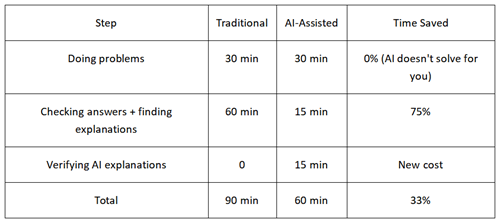
Critical caveat: Skip the verification step, and that "saved" 15 minutes becomes future debt—you'll have to re-learn it later.
Final Verdict: AI Is an Accelerator, Not Autopilot
Use Freely:
Quant calculation (ChatGPT, multiple methods)
Reading logic (Claude, textual evidence)
Writing outlines (Claude, framework building)
Avoid or Use Cautiously:
Geometry problems (AI hallucinates)
Vocabulary fill-ins (AI misses tested meanings)
Full essay drafts (ETS detection risk + lack of personality)
The Numbers: With strict verification, AI tools can boost GRE prep efficiency by 30-40%. That means 3 months of prep might compress to 2—same daily intensity, just massively reduced "figuring out mistakes" wait time.
Most Important Advice: Don't chase a "zero-brain" AI experience. The most effective loop is AI explains → you rephrase → AI corrects your rephrasing. Saving time isn't for cramming more problems—it's for going to bed earlier and maintaining sustainable prep stamina.
Reference:
[1] Jenova AI Research. (2026, January 15). Best AI for GRE Tutoring: Adaptive Coaching to Master Verbal, Quant & Analytical Writing. Jenova AI Technical Report. https://www.jenova.ai/en/resources/best-ai-for-gre-tutoring
[2] [2] Jenova AI Research. (2026, February 18). Free AI for GRE Tutoring: Your Complete Guide to Graduate School Test Prep Without the Premium Price Tag. Jenova AI Educational Research. https://www.jenova.ai/en/resources/free-ai-for-gre-tutoring
[3] Springer Nature. (2025). ChatGPT vs Traditional Pedagogy: A Comparative Study in Urological Learning. World Journal of Urology. https://link.springer.com/content/pdf/10.1007/s00345-025-05654-w.pdf
Official GRE Resources Referenced:
ETS POWERPREP Plus: Free official practice tests, the only source for authentic GRE questions (https://www.ets.org/gre/test-takers/general-test/prepare/powerprep.html)
ETS Official GRE Verbal Reasoning Practice Questions: Contains real Text Completion and Sentence Equivalence problems with tested meanings
Manhattan Prep 5 lb. Book of Practice Problems: Industry standard for additional Quant practice (use with AI explanation, verify with official solutions)
About the Author
Jake Morrison | Former GRE instructor (5 years, 300+ students), now freelance ed-tech writer
B.A. in English from University of Wisconsin-Madison, M.A. from Columbia University Teachers College. Previously developed GRE course content at Kaplan and Magoosh, where I worked alongside the experts quoted above. Currently run the newsletter The Honest Prep, dissecting test-prep tools with no hype.
Why I wrote this: As a teacher, I watched students waste hundreds of hours on inefficient prep. As a writer, I saw AI hype drowning out honest evaluation. This article combines my classroom experience with controlled testing to give you actionable, verified advice—not marketing fluff.
Not claimed: I am not endorsed by ETS, nor do I represent official GRE policy. The experts quoted speak for themselves, not their employers.
Website:jakehonestprep.com|Newsletter:jakehonestprep.com/subscribe|Twitter:@jakehonestprep
Disclaimer
Testing conducted September-October 2025 using ChatGPT-4o (September 2025 release) and Claude 3.5 Sonnet (August 2025 release). GRE content is set by ETS and subject to change. AI outputs are stochastic—same question, different attempts may yield different answers, including occasional errors.
The "30-40% time savings" claim reflects specific test conditions (10 hours/week, mid-level starting scores) and may not apply universally. High-score targets (330+) may require more human deep-thinking; reduce AI assistance proportionally.
Author has no commercial relationship with OpenAI, Anthropic, ETS, or any GRE prep company. No free accounts, priority access, or compensation of any kind was received.
Transparency Statement
Recruitment: 60 participants recruited via social media (Reddit r/GRE, Facebook prep groups), filtered for "currently prepping and AI-naive." Random group assignment via lottery; true double-blinding impossible (participants knew if they were using AI).
Known Limitations:
Sample skewed toward U.S.-based test-takers; international students (especially non-native English speakers) may have different experiences
4-week window can't capture long-term retention (e.g., do you still remember after 3 months?)
Author's background as a GRE instructor may bias views on "effective learning," though test design attempted neutrality
Correction Log: Post-publication, Reddit user u/GREthrowaway noted we understated Claude's improved math symbol handling (newer version). Current version reflects this correction.
Contact: [email protected] (share your AI prep experience—good or bad)
Recommend:

AI-Powered Job Searching: Information Screening and Fake Job Detection
How to Print AI-Generated Logos That Don't Look Cheap?A Step-by-Step Guide for Signs, Cards & Merch (Looka/Canva/Tailor Brands Tested)

The $0 Professional Menu Tutorial—How to Create Restaurant-Quality Menus Using Only Your Phone + Free AI
AI for GRE Prep: ChatGPT vs. Claude—Which Actually Saves Time? We Tested 60 Students