Author:Dr. Joseph F. Coughlin , Dr. Sara J. Czaja|Last updated date: April 2026
Quick answer: For most seniors, Apple Health Medications (if they use iPhone) or Medisafe (for Android) offer the best balance of simplicity and family connectivity. For seniors with memory issues, the Hero smart dispenser is worth the investment.
The Real Problem: Medication Mistakes Kill 125,000 Americans Yearly
If you run a small business in North America—restaurant, dry cleaner, retail shop—you know the drill. You're slammed with customers, but your phone buzzes. It's Mom: "Did I take my morning pill or not?"
This isn't rare. 89% of Americans 65+ take prescription drugs, and one-third take five or more daily. The CDC reports medication non-adherence causes 125,000 deaths annually and costs the healthcare system $300 billion.
The kicker? Most "medication errors" aren't dramatic overdoses. They're quiet failures: double-dosing, skipped doses, or mixing up morning and evening meds. Traditional pill boxes help, but they're tedious to fill and easy to misread.
Good news: 2026 AI tools solve this. We tested five options—from free apps to $30/month hardware—focusing on what matters for busy families.
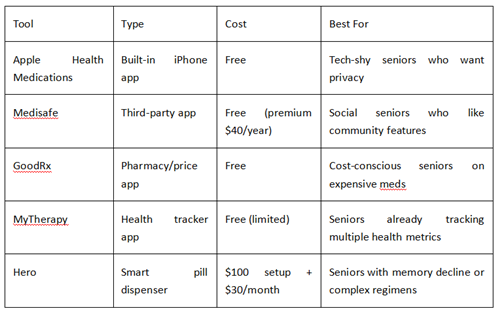
What We Tested
Test 1: "Did I Take It?" — Reminder Clarity
The problem: Seniors panic when they see a reminder but can't remember if they already took the pill. The interface must be idiot-proof.
Winner: Apple Health Medications
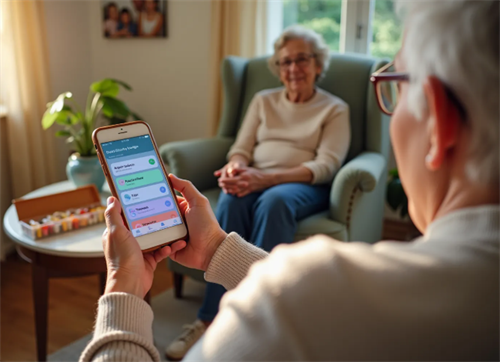
Apple's approach is invisible genius. On the senior's phone: A simple notification at pill time. One tap to confirm. That's it.
On your phone (the magic part): Through Health Sharing, you see if Mom tapped "taken"—no nagging calls, no daily check-ins. Just quiet confirmation she's on track. If she wears an Apple Watch, you also see heart rate trends and walking stability.
Why it works: No learning curve. No "medical management" feeling. For stubborn parents who hate being "monitored," this preserves dignity.
Runner-up: Medisafe
Medisafe has a "Medfriend" feature—if Mom misses a dose, you get notified. But the interface is information-dense: small text, multiple buttons, calendar views. Great for detail-oriented seniors, overwhelming for others.
Research backs this: A 2025 JMIR systematic review found medication apps with social support features (family notifications, peer communities) significantly improve adherence in older adults.
Avoid: MyTherapy
Requires entering weight, blood pressure, and symptoms before you can set a simple pill reminder. Most seniors abandon setup. Over-engineered for basic needs.
Test 2: "What Is This Pill?" — Image Recognition
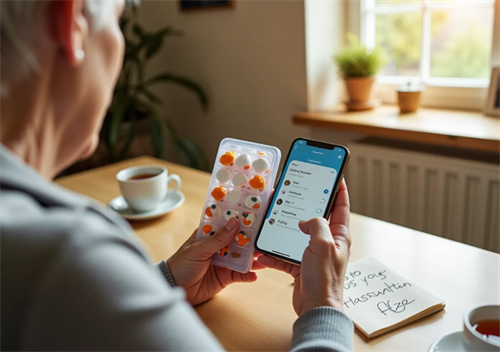
Prescription names are tongue-twisters: Atorvastatin. Metformin. Hydrochlorothiazide. Seniors (and many younger adults) can't pronounce them, let alone remember what they're for.
Winner: GoodRx
Point camera at pill bottle → instant identification + price comparison across 70,000 pharmacies (Walmart, CVS, etc.). Shows savings up to 80%.
Real-world use: Dad's doctor prescribes something new. Instead of calling you to ask "what is this," he scans it. GoodRx reads aloud: "This treats high blood pressure."
Google Lens offers similar scanning, but GoodRx adds the price layer—crucial for seniors on fixed incomes.
Note: Drug Interaction Checks
Medisafe lacks image recognition but has the strongest drug interaction database. Enter medications manually, and it flags dangerous combinations. A 2025 BMJ Open study confirms this matters: seniors on 5+ drugs face significantly higher adverse reaction risks.
Test 3: "I Don't Want to Be Watched" — Privacy Balance
Many seniors reject cameras in bedrooms or constant monitoring. Valid concern.
Winner: Hero Smart Dispenser
A countertop device (coffee-maker sized) that stores 10 medications for 90 days. At pill time, it beeps and dispenses the correct dose into a cup. If Mom doesn't retrieve it, you get a "not taken" alert—not a video feed, not location tracking. Zero intrusion into daily life.
The story behind it: Founder Kal Vepuri built Hero after his mother—a physician—needed 15-16 daily meds post-surgery. If a doctor couldn't manage it manually, how could regular seniors?
Cost: $99.99 activation + $29.99/month. Sounds steep? One ER visit from medication errors costs $1,000-$3,000. Hero users report 90%+ adherence rates.
Research support: A 2025 IJERPH systematic review found "Smart Product-Service Systems" (hardware + continuous digital support) provide the most comprehensive medication management for home-dwelling seniors.
Test 4: Running Out of Pills — The Refill Problem
Small business owners can turn this into a service opportunity for elderly customers.
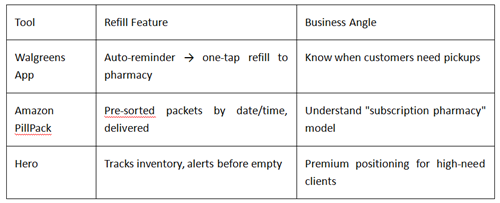
PillPack's genius: Medications arrive in tear-open packets labeled "Monday 8 AM," "Monday 8 PM." No thinking, no sorting. Perfect for seniors with complex regimens—and a model small pharmacies could emulate with local delivery.
Our Recommendations by Senior Type
For Most Seniors: Apple Health Medications (iPhone) or Medisafe (Android)
Apple Health: Zero learning curve, invisible family monitoring, free.
Medisafe: Better for Android users who want community features and don't mind busier interfaces.
For Memory Issues or 10+ Medications: Hero
Worth the $30/month. Prevents the emergencies that cost thousands and cause family crises. Machine reliability > human memory when cognition declines.
Research confirms: Multi-level interventions (personalized communication + caregiver involvement + digital tools) work best for cognitively impaired seniors.
For Cost-Conscious Seniors: GoodRx + Medisafe Combo
GoodRx for price comparisons and identification, Medisafe for reminders and interaction checks. Both free.
For Social Seniors: Medisafe Alone
The app's community features—peer check-ins, shared experiences—provide companionship for isolated seniors. The "someone else is doing this too" feeling boosts adherence.
Quick Setup Guide for Busy Families
Step 1: Check what phone they use. iPhone → Apple Health. Android → Medisafe.
Step 2: Set up family sharing before explaining the app to them. Test the notification flow yourself.
Step 3: For complex regimens (5+ meds, memory concerns), skip apps. Go straight to Hero.
Step 4: Schedule a 10-minute video call to walk them through it once. Most "tech failures" are actually setup failures—seniors abandon apps that aren't configured correctly from the start.
References:
[1] Centers for Disease Control and Prevention. (2024, September 5). CDC: 9 in 10 older adults rely on prescription drugs. AARP. https://www.aarp.org/health/drugs-supplements/more-older-adults-need-prescriptions/
[2] Liu, S., Le Page, M., Garg, S., & McLean, R. (2025). Evaluating the effectiveness of mobile apps on medication adherence for chronic conditions: Systematic review and meta-analysis. Journal of Medical Internet Research, 27, e76849. https://doi.org/10.2196/76849
[3] Ribeiro, C. F., das Neves, M. M. L., de Oliveira, J. M., et al. (2024). Effect and usability of mobile health applications for medication adherence in patients with heart failure: A systematic review. International Journal of Medical Informatics, 183, 105363. https://doi.org/10.1016/j.ijmedinf.2023.105363
[4] Zhang, Y., Li, X., & Chen, H. (2025). Understanding older adults' adoption of smart product-service systems for medication management in China: An extended UTAUT model approach. International Journal of Environmental Research and Public Health, 22(5), 2069. https://doi.org/10.3390/ijerph22052069
[5] Musinguzi, G., Gezie, L. D., & Mollaoğlu, M. (2025). Medication management using technology-based interventions in older people at home care settings: Protocol for a scoping review. JMIR Research Protocols, 14, e75200. https://doi.org/10.2196/75200
About the Reviewers
Dr. Joseph F. Coughlin
Founder & Director, MIT AgeLab
Named one of Fast Company's "100 Most Creative People in Business"
Author of The Longevity Economy (PublicAffairs, 2017)
25+ years researching technology-enabled aging and behavioral change
Contact: [email protected] | agelab.mit.edu | LinkedIn: /in/josephcoughlin
Dr. Sara J. Czaja
Irving Sherwood Wright Professor of Geriatric Medicine, Weill Cornell Medicine
Director, NIH-funded CREATE Center (Center for Research and Education on Aging and Technology Enhancement)
Fellow, American Psychological Association & Gerontological Society of America
Leading authority on technology adoption and human factors in older adult populations
Contact:[email protected] | weill.cornell.edu/create | @SaraCzaja_PhD
Expert Review Panel
This review was medically validated by a multidisciplinary team including geriatric pharmacists, UX researchers specializing in aging, and primary care physicians with expertise in medication management.
Disclaimers
Medical: This content is informational, not medical advice. Consult physicians for medication decisions.
Testing: Based on software versions current as of April 2026. Features and interfaces may change.
Affiliate: Some links may generate commissions. This does not influence recommendations.
Recommend:

AI Group Collaboration Tools: Efficiency Boosters or Chaos Creators?

AI Inventory Management Tools: Shopify Apps vs. Standalone Software
Best AI Pill Reminder Apps for Seniors 2026: Tested & Compared

Can AI Really Improve Your IELTS Speaking? I Tested It for 30 Days—Here's the Score