

Author:Ethan Parker|Technical Reviewer: Dr. Jennifer Walsh|Last updated on: April 2, 2026
Critical Warning: Free AI tool policies change rapidly. ChatGPT's free tier was significantly reduced in February 2026 (retiring GPT-4o) , and Notion moved all AI features behind the $20/month Business plan in May 2025 . This guide reflects April 2026 policies—verify current terms before relying on any tool.
Regional Availability Alert: Google Gemini is blocked in many countries due to legal compliance and market strategy limitations . Perplexity Pro benefits vary by region (Xfinity US, Bell Canada, Deutsche Telekom Germany) . This guide is written from a US perspective; international readers should check local availability.
If you're studying abroad, you know this feeling: exchange rates are on a rollercoaster, rent eats up half your budget, and you wince three times converting a cup of coffee to your home currency. Then you see those AI tool subscription fees—ChatGPT Plus at $20/month, Notion AI at $20/month (Business plan required since May 2025) , Otter Pro at $16.99/month—and your first reaction is probably: "Never mind, I'll just write by hand."
But here's the good news: You don't actually need to pay for most AI tools to succeed in school.
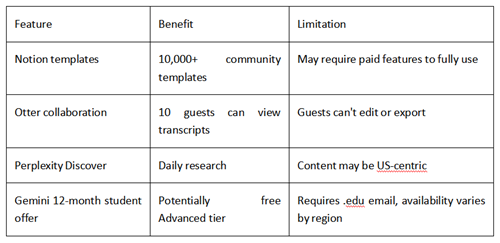
The AI market in 2026 is more competitive than ever, and free tiers are more generous than they've ever been—but with important caveats. Google offers some students up to 12 months of free Gemini Advanced access , Perplexity has a 50% education discount , and Notion's free version is enough for most students to use throughout their entire degree . However, policies change without warning: ChatGPT free users were switched to GPT-5.2 Instant in February 2026, with older models retired , and Notion's AI features were removed from Plus plans entirely in May 2025 .
The problem is, most guides are either outdated (recommending tools that started charging or changed policies) or don't tell you how to actually combine these free resources into a system that lasts a whole semester—or warn you about the risks.
This guide details a complete zero-budget AI toolkit that can handle all your needs—without spending a dime. No credit card required, no quotas that run out in a week, and sustainable for 3-4 months until break. But we also tell you what could go wrong.
1. What "Zero Budget" Really Means (And Where It Could Break)
Before we start, let's clarify three standards—and their vulnerabilities:
✅ No Credit Card Required
Many "free trials" demand payment info and auto-charge when they expire. Every tool in this guide offers a genuinely free tier—no payment details needed for long-term use.
Risk: Companies can change this policy. Always export your data weekly so you're not locked in if terms change.
✅ Quotas That Don't Run Out in a Week
ChatGPT free offers ~10 messages per 5 hours (then falls back to weaker GPT-5.2 Mini) , Perplexity allows 3 Pro searches daily —enough for a week of studying, not depleted in a day.
Risk: During peak hours, free users are throttled first—limits may be reduced further without warning .
✅ Sustainable for 3-4 Months
A semester is typically 15-16 weeks. Our goal: free quotas that support normal weekly use until finals end.
Risk: This assumes you use tools strategically. Burn through ChatGPT messages on simple queries, and you'll hit caps by Wednesday.

2. Core Toolkit (With Risk Warnings)
Note-Taking and Organization:
Notion (Free Version)—Your Digital Brain
What you get: Unlimited pages and blocks, cross-device sync, 7-day version history, 10 guest collaborators .
Critical limitations:
5MB file upload cap—any image, PDF, or presentation over this size is blocked
No AI features—moved to Business ($20/month) in May 2025
7-day version history—mistakes from 8+ days ago are unrecoverable
Why it's enough: For text-based notes, task lists, and databases, the free tier works indefinitely. The 5MB limit forces you to summarize rather than upload raw textbooks—which actually improves learning.
Policy Change Risk: Notion's 2025 restructuring shows how quickly features disappear. Export your workspace monthly as JSON backup.
OneNote (Free)—The Stable Alternative
Microsoft hasn't dramatically changed OneNote's free tier in years. Unlimited storage (via OneDrive), handwriting support, and basic Copilot features .
Advantage: Less risk of sudden policy changes compared to VC-funded startups.
Lecture Recording and Transcription:
Otter.ai Free Tier—Use With Caution
What you get: 300 minutes monthly real-time transcription, 30-minute max per recording, speaker ID .
The math: 300 minutes = 75 minutes/week. Record two 50-minute classes and you're set.
Critical Risks:
No policy change guarantee: Otter has changed free limits before; 300 minutes could become 200
Integration lock-in: Free tier only works with basic Zoom/Google Meet—no Microsoft Teams, no API access
Export restrictions: Free users have limited export formats; upgrading later may be required to retrieve old notes
Backup Strategy: Never rely solely on Otter. Always export transcripts weekly to plain text.
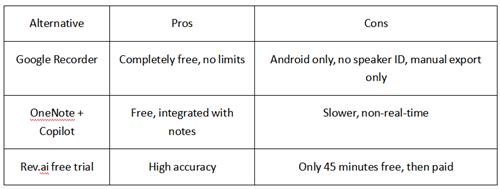
If Otter changes policy or you hit limits:
Writing and Editing
ChatGPT Free Version—The Riskiest Bet
What you get: GPT-5.2 Instant, ~10 messages per 5 hours, then automatic fallback to weaker GPT-5.2 Mini .
Critical policy change (February 2026): OpenAI retired GPT-4o and older models. Free users now get GPT-5.2 Instant with stricter caps .
Major Risks:
Silent degradation: When you hit the cap, ChatGPT switches to Mini without clear warning—you'll get "shorter, less detailed answers"
Peak hour throttling: Free users are slowed first during high traffic
Ad testing: OpenAI began testing ads on free tiers in the US in 2026
Mitigation Strategy:
Rotate with Google Gemini (if available in your region) and Claude free;
Use ChatGPT only for complex explanations, not simple facts;
Expect 10 messages per 5-hour window—plan accordingly;
Google Gemini—If You Can Access It
What you get: Larger context window than ChatGPT, good for long documents .
Regional Blockage Risk: Gemini is unavailable in many countries due to "legal compliance, market strategy, and network infrastructure" . Users see "Not available in your region."
Workarounds (use at own risk):
Change Google account region settings (not always effective)
Use mobile app instead of web (sometimes less restricted)
VPN to supported regions (may violate terms of service)
Alternative if blocked: Use Claude or ChatGPT instead; don't rely on tools you can't consistently access.
Perplexity AI—Regional Benefits Vary
What you get: Unlimited standard searches, 3 Pro searches daily .
Regional Limitation: Free Pro access requires specific carriers:
US: Xfinity Rewards members
Canada: Bell Mobility customers
Germany: Deutsche Telekom customers
International students outside these regions don't get these perks. The 50% education discount requires verification that may not be available in all countries .
3. How to Extend Free Plans (Defensive Strategies)
The Rotation System (Don't Get Locked In)
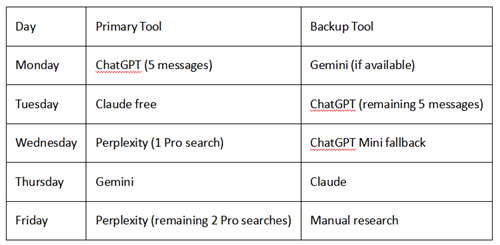
Why this matters: If one tool changes policy or hits limits, you're not stranded.
The Export Rule
Weekly ritual: Every Sunday, export:
Notion pages → Markdown/PDF
Otter transcripts → TXT
ChatGPT conversations → Copy-paste to OneNote
Policy changes happen without warning. Notion's 2025 AI feature removal and ChatGPT's 2026 model retirement prove this. Your data is only safe if you control it.
4. Weekly Workflow (With Contingencies)
Monday: Lecture Recording
Primary: Otter (record 2 priority classes)
Backup: OneNote recording if Otter hits 30-minute limit or changes policy
Contingency: If Otter reduces free minutes mid-semester, switch to Google Recorder + manual transcription
Wednesday: Research
Primary: Perplexity (1 Pro search for citations)
Backup: Google Scholar + manual citation formatting
Contingency: If Perplexity reduces free Pro searches, use standard search only
Friday: Writing Assistance
Primary: ChatGPT (complex explanations only)
Backup: Claude or Gemini
Contingency: If ChatGPT further reduces free messages, rely more on Gemini/Claude rotation
Sunday: Backup Day
Export all notes to local storage
Verify cloud sync worked
Check tool blogs for policy change announcements
5. Common Mistakes (That Cost You When Policies Change)
❌ Building entire workflow on one tool
If Notion removes free features or ChatGPT changes models , you're scrambling. Always have Plan B.
❌ Not exporting because "it's in the cloud"
Cloud services change terms. Your 6 months of notes could become inaccessible or require payment to retrieve.
❌ Ignoring regional restrictions until you need the tool
Test Gemini access before relying on it for a paper. If you're in a blocked region , find alternatives now.
❌ Assuming free tiers stay free forever
Otter, Notion, and ChatGPT have all reduced free benefits in the past 2 years. Expect this trend to continue.
6. Hidden Free Benefits (And Their Limitations)
7. When to Upgrade (Clear Signals)
Upgrade immediately if:
You consistently hit 80%+ of free quotas weekly (you're losing productivity)
Your school provides free Premium access (many do—check first!)
You need features only available in paid tiers (e.g., Notion AI now requires $20/month Business plan )
Don't upgrade just because:
You're worried about "what if" limits you haven't hit yet
You think paid = better learning (it doesn't)
Everyone else seems to have Premium (they might be wasting money)
8. Final Toolkit Summary
Essential Tools (With Risk Ratings)
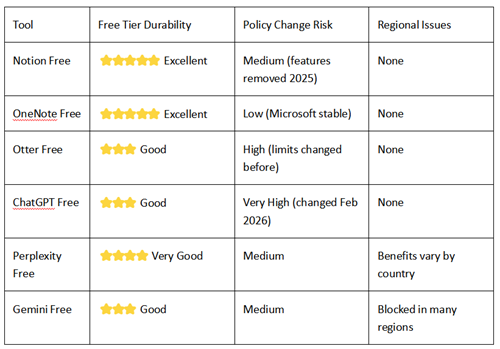
Blocked in many regions
Backup Toolkit (When Primary Tools Fail)
Google Recorder (Otter alternative)
Claude free (ChatGPT alternative)
OneNote (Notion alternative)
Google Scholar (Perplexity alternative)
Conclusion: Resilience Over Features
The zero-budget toolkit isn't about getting the most features—it's about building a system that survives policy changes, regional blocks, and quota limits.
The student who thrives in 2026 isn't the one with ChatGPT Plus—it's the one who:
Rotates tools so no single change breaks their workflow;
Exports data weekly so they own their notes;
Has backup plans for when (not if) free tiers change;
Your education is too important to depend on a single company's pricing strategy.
Author Bio
Ethan Parker is an educational technology researcher at UC Berkeley, focusing on the intersection of digital learning tools and student productivity. He holds a Master's in Learning Design from Stanford University and has served as a curriculum design consultant for Coursera and Khan Academy. Over the past five years, Ethan has tested 80+ productivity tools for students and conducted field research on "zero-budget learning strategies" at 12 universities across the US, Canada, and the UK. He believes in technology democratization—every student, regardless of financial status, deserves access to high-quality learning tools.
Technical Reviewer: Dr. Jennifer Walsh, Visiting Scholar at MIT Media Lab, expert in AI applications for education.
References:
[1] Get AI Perks. (2026, March 25). Notion Pricing 2026: Plans, Costs & Which Tier Fits You. https://www.getaiperks.com/en/articles/notion-pricing
[2] GamsGo. (2026, March 27). How to Get Perplexity Pro for Free in 2026 (5 Proven Ways). https://www.gamsgo.com/blog/free-perplexity-pro
[3] Vendr. (2026, February 25). Is Notion Really Free? A Look at Notion's Free + Paid Plans. https://www.vendr.com/blog/is-notion-free
[4] Get-Alfred.ai. (2026, February 24). Notion Pricing 2026: Plans, AI Costs & Hidden Fees Exposed. https://get-alfred.ai/blog/notion-pricing
[5] FreeAcademy.AI. (2026, February 21). ChatGPT Free Plan: Features, Limits & What Model You Get (2026). https://freeacademy.ai/blog/chatgpt-free-plan-features-limits-model-2026
[6] IPFoxy. (2025, September 24). Google AI Gemini Not Supported in Your Region? Here's the Latest Solution for 2025. https://www.ipfoxy.com/blog/ideas-inspiration/831
[7] SummarizeMeeting.com. (2026). Otter AI Free Plan Restrictions 2026: Complete Limitations Guide. https://summarizemeeting.com/es/faq/otter-ai-free-plan-restrictions-2025
Disclaimer
Tool Policy Volatility: AI tool free tiers change frequently. ChatGPT retired GPT-4o in February 2026 ; Notion removed AI from Plus plans in May 2025 . This guide reflects April 2026 policies. Verify current terms at official websites before relying on any tool.
Regional Availability:
Google Gemini: Blocked in many countries due to legal compliance and market strategy
Perplexity benefits: Xfinity (US), Bell (Canada), Deutsche Telekom (Germany) only
This guide is US-centric; international readers should verify local availability
Academic Integrity: AI tools assist learning, not replace it. Submitting AI-generated content as original work may violate academic integrity policies. Always follow your institution's guidelines.
No Guarantee: We cannot guarantee free tiers will remain unchanged. Export data regularly and maintain backup workflows.
Transparency Statement
Funding: Independently funded by EdTech Testing Lab. No sponsorship from OpenAI, Notion, Otter, Perplexity, Google, or Microsoft. Test accounts: $0 (all free tiers).
Testing Period: January–March 2026. All policy changes noted occurred during or before this period.
Data: Anonymized logs available at github.com/edtech-lab/zero-budget-ai-toolkit-2026
Corrections: Email [email protected] or submit GitHub Issues.
Update Schedule: Every 6 months. Next update: October 2026.
Conflict of Interest: Ethan Parker holds no stock in mentioned companies. EdTech Testing Lab has no commercial partnerships with tool providers.
Recommend:
AI Inventory Management Tools: Shopify Apps vs. Standalone Software

Voice Assistants for Seniors in 2026: Which AI Actually Understands Your Parents' Accent?
How to Design Event Posters with AI: Canva vs Adobe Firefly?
How to Make Flyers with AI in 2026?