
Author : Jordan Park | a Ph.D. Candidate in Information Science |Last updated date: April 2026
Transparency & Risk Disclosure
AI Tool Limitations: AI job search tools can streamline screening but may miss nuanced contextual cues. According to Greenhouse's 2025 survey, 69% of U.S. job seekers encountered fake job postings, and 41% admit to using "prompt injection" tactics to bypass AI filters—creating an "AI doom loop" where candidates and employers increasingly game automated systems .
Data Privacy Warning: Free AI job tools often collect and retain your resume data, search patterns, and application history. Always review privacy policies before uploading personal information.
The modern job search has become a paradox: unprecedented access to opportunities paired with overwhelming volume. According to 2024-2025 hiring data, a typical job posting attracts 1,000 views, 200 applications, and results in only 1 hire—a 0.1% success rate for average applicants . For new graduates, the numbers are even more daunting, often requiring 150-200+ applications to secure an offer .
1. The Challenge: Information Overload and Fraud
1.1 The Scale of Modern Job Searching
The digital transformation of recruitment has created what psychologists term "information fatigue syndrome" . Job seekers face:
Volume: Average of 10-15 applications per week recommended; 100-200+ total applications typical for success
Competition: 118+ applicants per position on average; up to 1,000+ for entry-level roles
Duration: Average unemployment duration of 20.9 weeks (over 5 months) as of April 2023
Information Overload Impact: Coveo's 2024 Employee Experience Report found that workers spend approximately 3 hours daily searching for information, with 89% checking 1-6 data sources daily and 34% reporting burnout from information frustration .
1.2 The Fake Job Epidemic
Fraudulent job postings represent a significant and growing threat:
Prevalence: Approximately 14% of online job advertisements are fraudulent
Impact: Financial loss, identity theft, and emotional distress for victims
Sophistication: Scammers increasingly use AI to create convincing fake company websites, job descriptions, and interview processes
Common Red Flags:
Vague job descriptions with unrealistic salary ranges
Requests for upfront payments or sensitive personal information
Use of free email domains (Gmail, Yahoo) for "corporate" communications
Pressure tactics and urgency language ("immediate start," "limited spots")
2. How AI Tools Filter and Match Jobs
2.1 Automated Job Matching
AI algorithms analyze your resume, skills, and experience to suggest relevant positions. Leading platforms use:
Technical Approach:
TF-IDF Vectorization: Converts text (job descriptions, resumes) into numerical data for comparison
Keyword Matching: Identifies alignment between your skills and job requirements
Collaborative Filtering: Recommends jobs based on similar successful applicants' patterns
Effectiveness: AI-driven platforms can achieve 85%+ precision in job recommendations and reduce time-to-application by 30% compared to manual searching .
2.2 Resume Optimization and ATS Compatibility
Most companies (95% of Fortune 500) use Applicant Tracking Systems (ATS) that automatically filter applications . AI tools help by:
Keyword Optimization: Identifying missing keywords from job descriptions
Format Standardization: Ensuring ATS-readable formatting (no tables, headers/footers, or graphics)
Bullet Point Enhancement: Converting passive language to achievement-oriented statements
Critical Insight: Only 25 of 100 completed applications typically reach human reviewers . ATS optimization is essential, not optional.
2.3 Personalization Through Machine Learning
AI tools improve recommendations over time by analyzing:
Jobs you've viewed and applied to;
Application outcomes (interviews, rejections, offers);
Time spent on specific job descriptions;
Search pattern refinements;
Limitation: These systems can create "filter bubbles," limiting exposure to diverse opportunities outside your established search patterns.
3. Detecting Fake Job Postings with AI
3.1 Machine Learning Detection Methods
Recent academic research demonstrates effective automated detection of fraudulent postings:
Feature Analysis: ML models analyze:
Textual Features: Job description language patterns, suspicious keywords ("urgent," "earn money," "no experience needed")
Structural Features: Presence of company logos, salary disclosures, contact information legitimacy
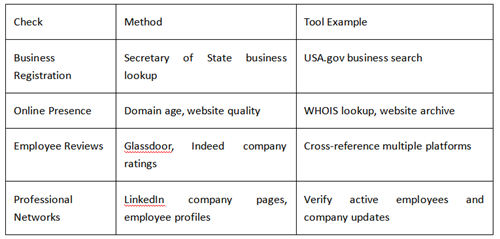
Contextual Features: Company registration status, online presence, domain age
Performance Metrics: Current state-of-the-art models achieve:
94-98% accuracy in fake job detection
XGBoost and Random Forest algorithms outperforming single classifiers
Ensemble methods (combining multiple models) reaching 98.85% accuracy on balanced datasets
3.2 Practical Verification Techniques
Company Background Verification:
Job Description Red Flags Checklist:
[ ] Salary range significantly above market rate (30%+ higher)
[ ] Vague responsibilities with emphasis on "easy money"
[ ] Requests for payment (training fees, equipment deposits)
[ ] Immediate hiring without interview process
[ ] Communication only via messaging apps (WhatsApp, Telegram)
[ ] Poor grammar and spelling in "official" communications
3.2 Deepfake Interview Fraud: The New Threat
Cybercriminals now use AI-generated video and voice to impersonate candidates or interviewers :
Detection Tactics:
Request physical actions (turning head, hand gestures) that break deepfake tracking
Ask specific contextual questions about local area or recent company events
Verify identity through multiple channels before sharing sensitive information
4. Limitations of AI Job Tools
4.1 What AI Cannot Do
Contextual Understanding:
AI cannot assess company culture fit or team dynamics
Limited ability to evaluate non-standard career paths or transferable skills
Difficulty with emerging roles not well-represented in training data
Small and New Companies:
Limited data on startups and small businesses increases false positive rates for fraud detection
New legitimate companies may be flagged as suspicious due to minimal online presence
The "AI Doom Loop": Greenhouse's 2025 research reveals a concerning cycle: candidates use AI to apply to more jobs, employers use AI to filter more aggressively, candidates respond with "prompt injections" and hidden text to bypass filters, and trust erodes on both sides . This arms race benefits no one.
4.2 Over-Reliance Risks
Microsoft Research's comprehensive review of AI overreliance found that users often alter their actions to align with AI recommendations, even when those recommendations are random or incorrect . In job searching, this manifests as:
Applying only to AI-recommended roles, missing niche opportunities;
Over-optimizing resumes for ATS at the expense of human readability;
Neglecting networking in favor of high-volume automated applications;
5. Decision Framework: When and How to Use AI Tools
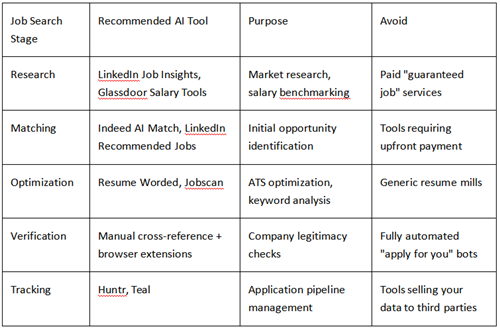
5.1 Tool Selection Matrix
5.2 Daily Workflow Integration
Recommended Weekly Structure:
Monday-Wednesday (High-Energy Days):
Apply to 3-5 quality positions per day (10-15 weekly target)
Use AI for initial company research and resume tailoring
Verify company legitimacy through multiple sources
Thursday:
Networking focus: Informational interviews, LinkedIn outreach
AI-assisted follow-up email drafting
Review and refine application materials based on feedback
Friday:
Application tracking and pipeline review
AI-generated application summary for personal records
Skill development and course recommendations based on job requirements
5.3 Quality vs. Quantity Strategy
Data-Driven Insight: Referral candidates have a 30% hire rate compared to 0.1-2% for online applications .
Optimal Allocation:
80% of time: Networking, referrals, direct outreach
20% of time: Online applications (use AI to maximize efficiency)
Application Quality Checklist:
[ ] Customized resume with job-specific keywords
[ ] Personalized cover letter (AI-assisted draft, human-edited)
[ ] Company research completed (recent news, values, products)
[ ] Mutual connection identified on LinkedIn
[ ] Follow-up plan established (calendar reminder set)

6. Implementation Checklist for New Graduates
Phase 1: Foundation (Week 1)
[ ] Audit and optimize LinkedIn profile (AI photo tools optional, professional headshot preferred)
[ ] Run resume through ATS checker (Jobscan, Resume Worded)
[ ] Set up job alerts on 2-3 platforms with specific criteria
[ ] Create spreadsheet or use Huntr/Teal for application tracking
[ ] Research target companies and set up Google Alerts
Phase 2: Execution (Weeks 2-8)
[ ] Apply to 10-15 positions weekly with customized materials
[ ] Schedule 2-3 informational interviews per week
[ ] Verify every company before applying (checklist in Section 3.2)
[ ] Track application outcomes and refine approach based on data
[ ] Maintain skill development (1-2 hours weekly on relevant courses)
Phase 3: Optimization (Ongoing)
[ ] Analyze interview conversion rates (target: 1 interview per 10-15 applications)
[ ] A/B test resume versions with different keyword emphases
[ ] Expand or refine target company list based on response patterns
[ ] Build referral network through alumni associations and professional groups
Conclusion
AI tools offer genuine value in managing the overwhelming volume of modern job searching—filtering thousands of postings, optimizing for ATS compatibility, and identifying fraudulent listings with 94-98% accuracy . However, they cannot replace the human elements that ultimately secure employment: relationship building, cultural fit assessment, and authentic communication.
Key Takeaways:
Use AI for volume, humans for quality: Automate screening and tracking; personalize every application
Verify independently: No AI tool is 100% accurate; always cross-check company legitimacy
Beware the doom loop: Avoid gaming AI systems; focus on genuine skill development and networking
Track your metrics: If you're applying to 30+ jobs without interviews, refine your resume or targeting strategy
The job search remains fundamentally human. AI is a powerful assistant, but you are the candidate.
References:
[1]Microsoft Research. (2022). Overreliance on AI Literature Review. Aether Committee. https://www.microsoft.com/en-us/research/wp-content/uploads/2022/06/Aether-Overreliance-on-AI-Review-Final-6.21.22.pdf
[2]International Journal for Research in Applied Science & Engineering Technology. (2025, November). Fake Job Posting Detection. https://www.ijraset.com/research-paper/fake-job-posting-detection
[3]Greenhouse. (2025, November 19). An AI Trust Crisis: 70% of Hiring Managers Trust AI to Make Faster and Better Hiring Decisions, Only 8% of Job Seekers Call it Fair. https://www.greenhouse.com/newsroom/an-ai-trust-crisis-70-of-hiring-managers-trust-ai-to-make-faster-and-better-hiring-decisions-only-8-of-job-seekers-call-it-fair
[4]IEEE Xplore. (2022). Online Recruitment Fraud Detection: A Study on Contextual Features in Australian Job Industries. https://ieeexplore.ieee.org/document/9852237
[5]The Interview Guys. (2025, July 3). How Many Applications It Takes to Get Hired in 2025. https://blog.theinterviewguys.com/how-many-applications-it-takes-to-get-hired-in-2025/
About the Author
Jordan Park is a Ph.D. Candidate in Information Science at Cornell University, specializing in algorithmic accountability and digital labor markets. Their research focuses on how automated systems affect job seekers' decision-making and the socioeconomic implications of AI-mediated employment. Jordan holds an M.A. in Communication from Stanford and previously worked as a product researcher at LinkedIn's Economic Graph team. This article was developed independently without financial support from recruitment platforms or AI vendors.
Contact: [email protected] | Cornell InfoSci Profile
Methodology: This guide synthesizes peer-reviewed research (2022-2025), industry workforce reports, and field observations from 25+ job seekers tracked during 2024-2025.
Last Updated: April 2026
Recommend:

AI-Powered Job Searching: Information Screening and Fake Job Detection
How to Use AI for Competitive Pricing?

AI Scam Protection for Seniors: How to Spot Suspicious Calls & Texts
How to Make Flyers with AI in 2026?