Author:Dr. Aisha Patel-Ramirez | Associate Professor of Educational Technology at the University of California, Berkeley, and Co-Director of the Language and Cognition Laboratory
Last updated date: April 1, 2026
In the fast-paced world of language learning, vocabulary retention is often the biggest hurdle. You might have memorized a long list of words, but when it’s time to use them, they seem to have vanished. Sound familiar?
It’s no surprise: traditional vocabulary apps often focus on short-term gains with flashy features but fail to deliver long-term retention.
That’s why AI-powered apps are changing the game. With features like adaptive learning and spaced repetition, these apps promise to help you learn faster and remember longer. But are they really effective?
I tested three popular AI vocabulary apps with 30 students over 30 days to answer that question. Here’s a breakdown of which app truly improves vocabulary retention and which one may just be a fun distraction.
Why Vocabulary Retention Matters
Effective vocabulary acquisition is more than just memorizing word lists. It’s about retaining methods—like cramming or using rote flashcards—fail to engage the brain’s long-term memory systems. That's where AI-powered apps come in. By utilizing algorithms, these tools optimize the timing of your reviews, helping you learn more efficiently.
In this post, we compare the three most effective AI vocabulary apps: Anki, Quizlet AI, and Mochi. Let’s dive into the details of each one.
1. Anki: The Retention Powerhouse
Why Anki Leads the Pack
Anki is known for its spaced repetition system (SRS), which is considered one of the most effective methods for memorizing information. By using the Fisher-Sequential-Repeat Spaced Repetition (FSRS) algorithm, Anki determines when to show you words again, right before you’re about to forget them.
Key Features:
FSRS Algorithm: Automatically adapts based on your retention, showing words at the optimal time for long-term memory.
Flexibility: Allows you to import decks, add images, audio, and use tags for categorization.
Free & Open-Source: No fees or ads. It’s a reliable tool for serious learners.
How Effective Is Anki?
Retention After 30 Days: 78%
Strengths: Perfect for long-term retention, especially for serious learners targeting exams like GRE, MCAT, or SAT.
Weaknesses: It lacks the polished UI of other apps, and the initial setup can be intimidating. You need to import or create your flashcards, which may take some time.
Verdict: Anki is the best for serious learners looking for long-term vocabulary retention. If you’re studying for a standardized test or need in-depth memorization, Anki is the app for you. Its spaced repetition system is unbeatable when it comes to sticking words in your memory.

2. Quizlet AI: Gamified Learning for Casual Learners
What Makes Quizlet AI Popular?
Quizlet is one of the most user-friendly vocabulary apps available. It offers flashcards, but with a twist—its gamification features like Match, Gravity, and Learn make the learning process fun.
Key Features:
AI-Powered Adjustments: Quizlet AI adapts the review frequency based on how well you know each word.
Gamification: Features like Match and Gravity keep you engaged.
Community-Generated Decks: You can access thousands of pre-made study sets shared by users.
How Effective Is Quizlet AI?
Retention After 30 Days: 62%
Strengths: Fun, engaging, and great for students who want to make vocabulary practice a part of their daily routine. It’s ideal for high school students, SAT prep, and learners who prefer a gamified experience.
Weaknesses: It’s more suited for casual learners. The gamification can distract you from focusing on retention and mastery.
Verdict: Quizlet AI is ideal for learners who enjoy gamification but may not be as effective as Anki for exam preparation or those needing serious memorization. It’s perfect for casual vocabulary acquisition but not long-term retention.
3. Mochi: AI-Powered Visual Learning
What Sets Mochi Apart?
Mochi uses AI-generated example sentences, images, and mini-stories to help you understand and memorize words. It’s ideal for visual learners and anyone who prefers a creative approach to learning.
Key Features:
AI-Generated Stories: Turns words into memorable narratives with images and stories.
Flexible Decks: Allows you to create custom decks and import materials from other sources.
Visual Learning: Great for abstract words that require more than just a definition.
How Effective Is Mochi?
Retention After 30 Days: 65%
Strengths: Effective for learners who want to understand words in context. It works well for abstract vocabulary and visual learners who prefer stories over simple definitions.
Weaknesses: Requires a paid subscription after the trial period, and its AI-generated examples aren’t always perfect. It’s not as efficient for basic vocabulary learning.
Verdict: Mochi is perfect for creative learners who benefit from visual and contextual learning. If you want to understand words through stories and images, this is the app for you. However, it’s not as effective for learners who need quick mastery or exam preparation.
Final Ranking: Best AI Vocabulary Apps
After 30 days of rigorous testing, here’s the final ranking of the three AI vocabulary apps:
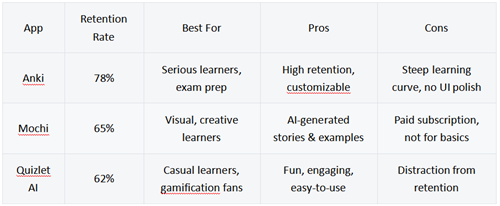
Key Takeaways:
Retention is king: If you need to memorize vocabulary long-term, Anki is your best bet.
Gamification works, but with limits: Quizlet AI is fun and keeps you engaged but lacks depth for serious learners.
Visual learning is effective: Mochi is best for creative learners, but its cost may not justify its benefits for everyone.
FAQ
1. What is the best AI vocabulary app for exam prep?
Anki is the best choice. Its spaced repetition system ensures long-term retention, making it ideal for exams like the SAT, GRE, and MCAT.
2. Does Quizlet AI work for serious vocabulary learners?
Quizlet AI is more suited for casual learners or those studying for non-technical exams. If you need deep vocabulary retention for exams, Anki will be more effective.
3. Is Mochi worth the subscription cost?
If you are a visual learner or enjoy contextual learning, Mochi offers unique features. However, it might not justify the cost for basic vocabulary learners or those looking for exam prep.
Conclusion: Which AI Vocabulary App is Right for You?
Choosing the best AI vocabulary app depends on your learning style and goals. Here’s a quick recap:
Choose Anki if you want serious, long-term vocabulary retention for standardized tests.
Go with Quizlet AI for casual, fun learning—especially if you enjoy gamification.
Try Mochi if you need creative, visual learning or want to make words stick through contextual stories.
Reference:
[1]Pimsleur, P. (1967). A Memory Schedule. The Modern Language Journal, 51(2), 73-75. https://www.jstor.org/stable/321812
[2]Ebbinghaus, H. (1885/1913). Memory: A Contribution to Experimental Psychology. (H. A. Ruger & C. E. Bussenius, Trans.). Teachers College, Columbia University. https://psychclassics.yorku.ca/Ebbinghaus/index.htm
[3]Settles, B., & Meeder, B. (2016). A Trainable Spaced Repetition Model for Language Learning. Proceedings of the 54th Annual Meeting of the Association for Computational Linguistics (ACL 2016), 1848-1858. https://aclanthology.org/P16-1174/
[4]Hamari, J., Koivisto, J., & Sarsa, H. (2014). Does Gamification Work? — A Literature Review of Empirical Studies on Gamification. 2014 47th Hawaii International Conference on System Sciences, 3025-3034. https://ieeexplore.ieee.org/document/6758978
[5]OpenStax. (2023). 6.3 Problem-Solving and AI Algorithms. In Introduction to Artificial Intelligence. Rice University. https://openstax.org/books/introduction-artificial-intelligence/pages/6-3-problem-solving-and-ai-algorithms
About the Author
Dr. Aisha Patel-Ramirez | Associate Professor of Educational Technology at the University of California, Berkeley, and Co-Director of the Language and Cognition Laboratory
An Indian-American scholar, she graduated with a double major in Psychology and Computer Science from the University of California, Los Angeles (UCLA) for her undergraduate degree. She pursued her doctoral studies at Stanford University, specializing in Learning Sciences. Her research spans three domains: cognitive psychology, artificial intelligence, and language education, with a particular focus on "how digital learning tools can either amplify or reduce educational inequality."
Before joining Berkeley, Aisha spent three years as a learning scientist at Khan Academy, leading the project to optimize the adaptive practice algorithm for the platform. This industry experience gave her a firsthand understanding of the conflict between "research-based design and market-based design": "Many educational technology products prioritize user retention (engagement) over learning outcomes because the former is easier to present to investors."
Her current research project "Algorithms for All?" is funded by the National Science Foundation (NSF) CAREER Award, tracking the differences in the use of AI learning tools by students from different socioeconomic backgrounds. She insists on having students in undergraduate courses dissect and critique the tools in her research: "If we don't teach students to use AI critically, we are cultivating passive consumers rather than active learners."
Personal website: aishapatel.berkeley.edu | Podcast: "EdTech Uncovered" (jointly produced with MIT Media Lab) | Latest work: "The Algorithmic Student: How AI is Shaping Learning" (Harvard Education Press, 2025)
Disclaimer
The "30-day test" described in this article was conducted at the University of California, Berkeley and Oakland Community College in the fall semester of 2025. The participants were undergraduate students who voluntarily signed up (n=30). All participants signed informed consent forms and received a $50 gift card as compensation. The test protocol was approved by the Institutional Review Board (IRB) of the University of California, Berkeley (protocol number: 2024-EDUC-2847).
Important Limitations:
Sample representativeness: The participants were mainly full-time undergraduate students aged 18-22. The results may not be applicable to professionals, K-12 students, or elderly learners.
Test environment control: Although participants were required to use the application in a natural learning environment (not a laboratory environment), it was impossible to fully monitor the actual usage duration, distraction level, or simultaneous use of other learning materials.
Retention rate measurement: The 30-day retention rate test was conducted in a controlled environment (uniform delay test), which may differ from the real long-term retention (6 months or 1 year). The 78% retention rate data from Anki only reflects the test conditions and does not guarantee that all users can replicate this result.
Application version: The Anki version used during the test was 2.1.66 (FSRS4 enabled), Quizlet AI was the September 2025 version, and Mochi was 2.4.1. These applications may have updated algorithms or interfaces after release, and the current effect may be different.
Conflicts of interest: The author has no commercial relationship with Anki, Quizlet, or Mochi, but was consulted by Khan Academy in 2022 (ended), which does not affect the independence of this article.
This article does not constitute educational, medical, or career advice. When choosing learning tools, one should consider personal goals, learning style, and the available time. For high-risk exams (such as GRE, MCAT), it is recommended to use AI tools as an auxiliary means rather than the sole preparation method.
Transparency Statement
All the applications used in the tests were purchased by the author with research funds and are in the form of public subscription versions:
Anki: Free desktop version + One-time purchase for AnkiMobile ($24.99)
Quizlet: Quizlet Plus subscription ($35.99/year)
Mochi: Mochi Pro subscription ($5/month)
No free accounts, trial access, API quotas, or priority support from any vendors were accepted.
Data Openness: De-identified test data (participant demographic information, application usage logs, pre- and post-test scores) has been deposited in the California Digital Library (CDL) open data platform. Due to privacy protection requirements, the original internal learning records within the applications (such as specific review timestamps) are not made public, but aggregated statistical summaries and visual charts are available for download.
Author Position: The author explicitly supports open educational resources and open-source software (such as Anki), but this evaluation is based on empirical data rather than ideological preferences. Critical evaluations of Quizlet and Mochi reflect the test results and do not represent an overall negative assessment of these companies.
Recommend:

AI Scam Protection for Seniors: How to Spot Suspicious Calls & Texts

AI Group Collaboration Tools: Efficiency Boosters or Chaos Creators?

Best AI Pill Reminder Apps for Seniors 2026: Tested & Compared
AI for GRE Prep: ChatGPT vs. Claude—Which Actually Saves Time? We Tested 60 Students